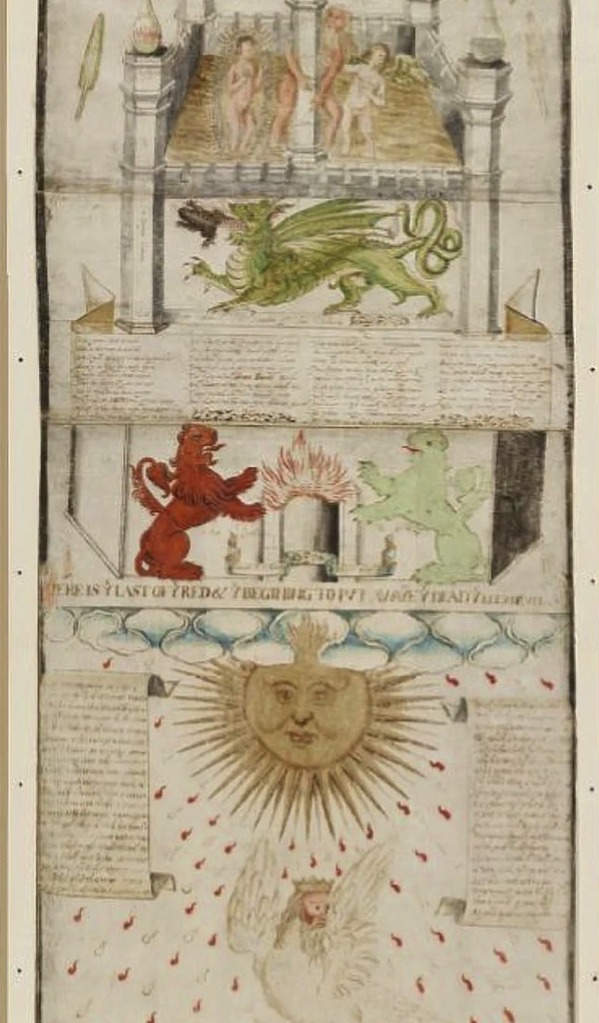
The Philosopher’s Stone: 16th Century Alchemy Scroll

-

In the ancient science of Alchemy, it seems that Philosophers and Alchemy went hand in hand.

Many Alchemists sought after the Philosopher’s Stone, which from my understanding is a mythical stone that transforms common metals into precious ones. 

Achieving this is like reaching Enlightenment for Alchemists of the old world.

Before I jump to conclusions, which happens when I see gruesomely slow sacrificial elements, I have to remember in my reading they seem to use lot of symbolism, analogies and strange riddles to describe life philosophically and physical processes. I only hope I’m misinterpreting some of the imaginary here.

This is the second page to the scrolls, being that there were two. I included the decipherable text which talks about the stages of the stone, most of the words are brushed off.

I was surprised to see something from the 1500s in plain English to observe and shudder at the tales of the Philosopher’s Stone.

References

Calisphere

Tartarian Talisman
Tartarian Talismanhttps://instagram.com/tartariantalisman
Tartarian Talisman unravels the past through hidden history, forgotten architecture, and the lost knowledge of free energy. With a relentless curiosity for antiquity, she challenges the mainstream narrative, piecing together clues that history tried to erase. **author has no other social accounts**
Subscribe
Notify of
guest

0 Comments
Oldest
Newest Most Voted

Latest articles

Vitrified Forts: Where the Stone Itself Melted

Stone is meant to last forever. It weathers and it erodes, but it does not melt under ordinary conditions....

Old World Energy: The Atmospheric Electric Circuit

Any physicist will tell you that energy can be neither created nor destroyed. It changes form and it moves,...

All Hallows’ Eve: The Evening Watch of the Whole Ones

On the night when witches and skeletons parade the streets and candy flies from plastic buckets, it is easy...

The Fleur-de-Lis: The Flower That Marks the Meeting Point

A mariner’s compass made around 1719 carries a small fleur-de-lis at the top of its card, marking north. Nobody...
spot_imgspot_img

Athelstan: King of Malmesbury and the Forgotten Library

Before The Canon IV In the centre of Malmesbury, in the county of Wiltshire, a great arch opens onto empty...

Lake Nemi: The Floating Palaces of Diana’s Mirror

On 15 July 1535, a Bolognese soldier and engineer named Francesco de' Marchi went down into Lake Nemi inside...

Must read

The Giant of St. Germain: Folklore or Hidden History?

The discovery of the tomb of Isoret, as documented...

What Melted the World? An Overview of the Meltology Theory

We’re testing human voice audio on select articles, tell...
spot_imgspot_img

You might also likeRELATED
Recommended to you